What an all-night gong ceremony revealed about being held by others.
I. The Night That Held Me
People are not what they think about themselves.
Take this example.
For most of my life, I saw myself as someone who loved solitude — sensitive, inward, content on the edges of things. I could lead groups, but I often did so from a distance. It wasn’t dislike; it was a quiet need to protect my inner space.
So what happens when such a person spends the whole night in a room with many others?
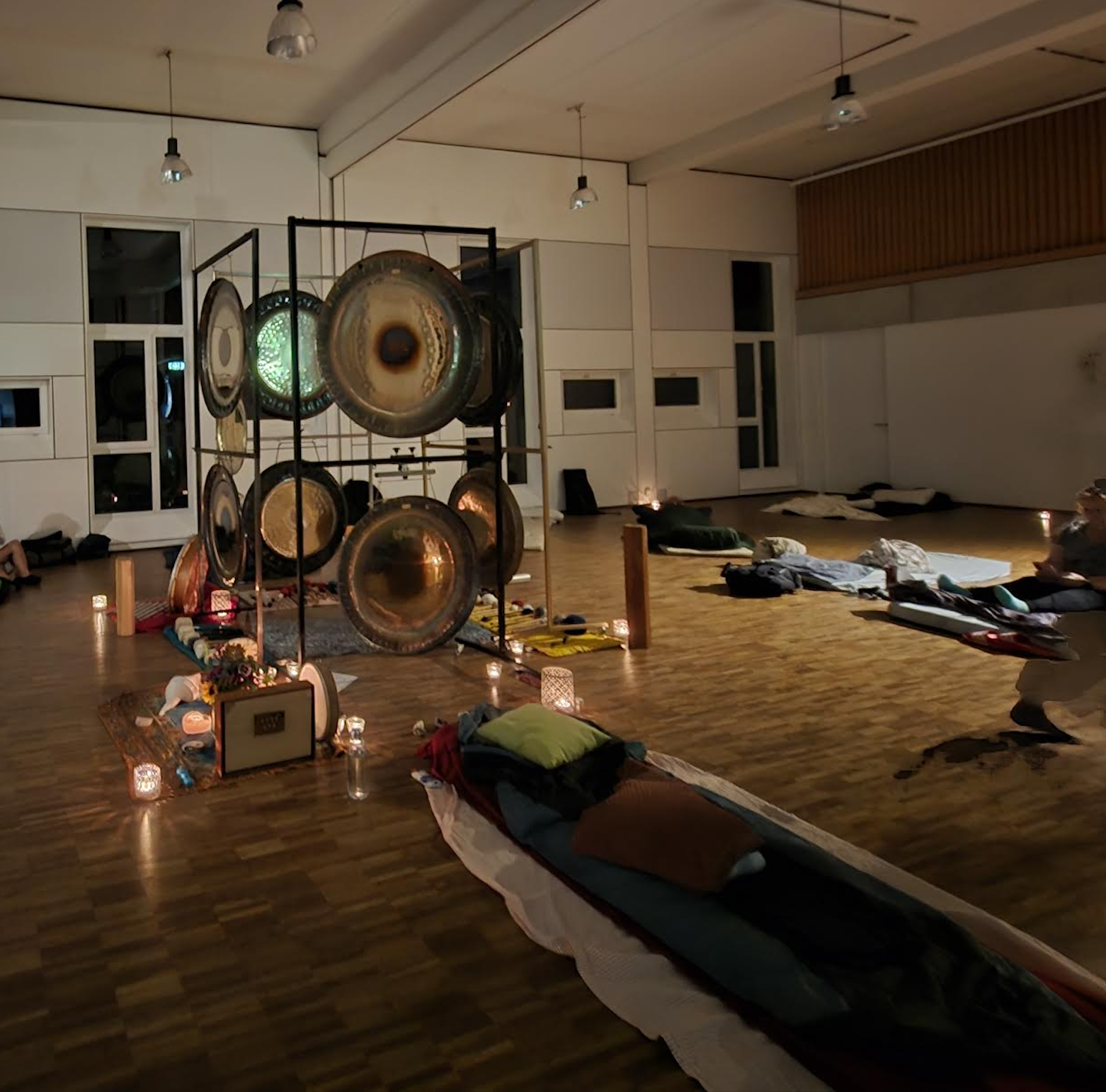
That question met its answer in an all-night gong ceremony I had the honor to participate in recently.
In this ceremony, each of us lay in our own cocoon — wrapped in blankets, eyes closed, a small island of quiet. Yet we were all in the same room, breathing the same air, surrounded by the vibrations of the gongs that played continuously through the night.
There was no conversation, no pressure to interact. Just presence — together but alone, alone but together.
At first, I thought I was the one holding the group — keeping the rhythm, tending the sound, watching over their rest. But as the hours passed and the night deepened, I realized something else was happening: the group was holding me.
Yes, I was still facilitating — still playing the gongs in that quiet, whispering way — but I felt sustained. I felt part of something larger than my separate self.
How could that be, and how could it be so effortless?
Upon reflection, I arrived at this: when we go through something transformative together, even without speaking, something shifts. The edges between people soften. The usual separations — participant and participant, facilitator and participant, self and other — dissolve naturally. The stillness of others becomes your stillness. Their surrender steadies yours.
And this realization led me to wonder: Is there anywhere else in the world where people intentionally stay together through the night?
I mentioned this question to a friend, and surprisingly, she told me that there is such a culture in this world — the Māori.
II. The Māori Way of Staying Together Through the Night
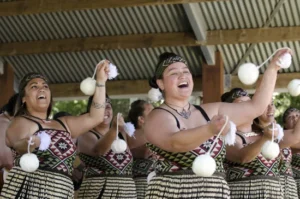 What my friend shared opened a new perspective — that what I had stumbled upon through experience already lives as tradition in another culture.
Among the Māori of Aotearoa New Zealand, there is a long-standing practice of communal overnight gatherings. When people come together on the marae — the community meeting ground — they do not disperse when night falls. Instead, they sleep together in the wharenui, the meeting house that represents an ancestor.
The wharenui is not just a hall. It is a symbolic body: the ridgepole the spine, the rafters the ribs, the carvings the genealogy. To sleep within it is to rest inside the ancestral embrace.
“The chance to sleep overnight on the marae is a precious opportunity to reconnect with each other.”
“Sleeping at your own pā… is a special type of rongoā.”
During tangihanga (funeral ceremonies), family and friends remain with the deceased for several nights so the person is never left alone. The night is not a pause; it is part of the ritual — a continuation of care and community.
In these settings, wairua — the spiritual dimension — is held collectively. The continuity of presence keeps the mauri, the life force, unbroken. It’s not only solidarity; it’s relationship — with each other and with the unseen world.
What the Māori understand is that being together through the night transforms what “together” means. It is not conversation or performance. It is trust — closeness without intrusion, presence without demand.
This isn’t just an ancient form; it’s a timeless human art — a way to restore community through proximity, silence, and shared time.
III. What It Teaches Us About Being Together
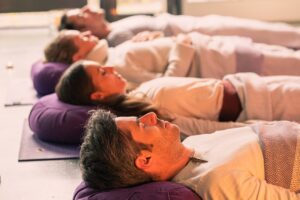
And that brought me back to Europe — to us.
We value privacy, and rightly so. We cherish the quiet of our own rooms, the freedom to withdraw. But we often pay a hidden price. The same privacy that protects us can also isolate us. The same solitude that nourishes us can harden into loneliness.
So the question becomes: Is there a middle ground?
Perhaps there is — a way to be with others that feels spacious rather than crowded, natural rather than forced. A way to share silence without losing oneself.
That’s what the night of the gongs revealed to me. Community doesn’t always require words or closeness; it sometimes begins by not leaving — by staying through the night, letting others exist beside you while sound and stillness do their quiet work.
Maybe this is what the Māori have known all along: that healing and connection arise not from activity, but from shared presence that lasts until morning.
An invitation. You don’t need a marae or a gong to feel this. It might begin by staying a little longer after an event, by being together in quiet without rushing home, by noticing what happens when you simply remain.
Because learning to be held — silently, naturally, without performance — may be one of the most transformative things we can do.
And in that remembering, we might rediscover something simple and ancient: that we are not what we think about ourselves — and that the night, when shared, can show us who we truly are.